Legacy
What survives?
No office. No monument he built. One postage stamp, a shelf of books, and a phrase that has outlived the man in it.
Afterwards
A legacy made of paper
Measure Pal by the usual instruments of national memory and he scores badly. He never held office. He founded no university, no party, no trust. He commanded no campaign that ended in a treaty. The organisation he helped radicalise had moved past him a decade before he died.
Measure him by what can still be read, and the picture changes completely.
The six Madras lectures of May 1907 were printed the same year and are digitised and publicly readable now. The Spirit of Indian Nationalism (1910), The Soul of India (1911), Nationality and Empire (1916), Responsible Government (1917), Indian Nationalism (1918), Non-co-operation (1920) and Swaraj: What Is It? (1922) sit in library catalogues. His memoir was published in the year he died.
This is a specific and slightly unusual form of survival. Most political leaders of his period are known through what others wrote about them. Pal is available in his own words, at length, on the record, arguing. You can check him. You can disagree with him on the evidence. Very few of his contemporaries left that possibility open.
It also means his legacy is unusually verifiable. Every substantive claim on this website can be traced to something he or a contemporary put into print — which is precisely the kind of afterlife a journalist would want.
How he is actually remembered
Honestly assessed, in four parts.
This site does not list memorials, institutions, roads or honours that it has not been able to verify. Where public commemoration exists that is not recorded here, corrections are welcome — see Contact.
Seventeen years later
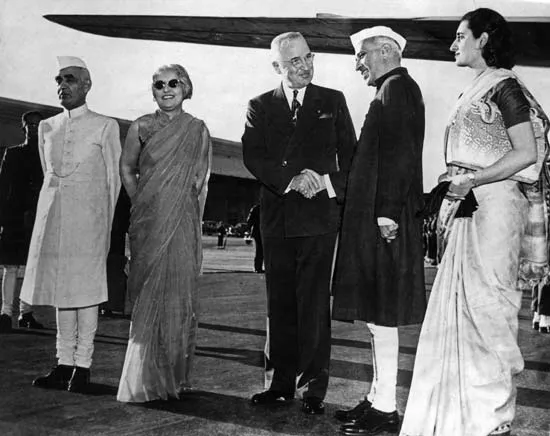
Pal died in 1932. By 1949 India was independent, partitioned, and being received as a sovereign state by the leading power of the post-war world.
He would have recognised some of it and found some of it unbearable. The economic self-reliance he had argued for in 1907 became state policy. The national education question he raised in the same year became a founding preoccupation of the new republic. Responsible government — the subject of his 1917 book — arrived.
And Bengal was partitioned. The province he had told a Madras audience in 1907 that no government had the power to divide was divided in 1947, and his birthplace at Poil in Sylhet ended up in another country. Whether that vindicates or refutes what he said depends on how you read him: as a prediction about administrative capability, which was wrong, or as a claim about cultural continuity, which is harder to settle.
This is what it means to say a thinker's legacy is genuinely contested. He was not simply proved right, and pretending otherwise would be a poor way to honour someone who built a career on precise argument.
Why he is under-read
Four reasons, none of them about the quality of his work.
He wrote arguments, not slogans. National memory transmits phrases. Tilak's claim that Swaraj is a birthright travels; a two-hour lecture interrogating the phrase “self-government under British paramountcy” does not.
He was on the losing side of the last argument. Opposing Gandhi's non-co-operation in 1920 placed him outside the narrative that Indian nationalism subsequently told about itself. Losers of internal arguments are not usually well served by the histories the winners' movements produce.
He built nothing that carried his name. Institutions maintain the reputations of their founders. Pal founded newspapers, and newspapers close.
He died too early and too quietly. Fifteen years before independence, outside the organisation, in reduced circumstances. There was no moment at which the new nation had an obvious occasion to claim him.
The event
A stamp, in 1958
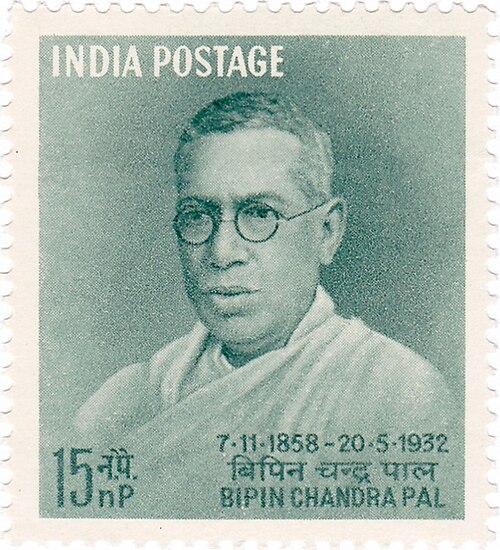
On the hundredth anniversary of his birth, the Government of India issued a 15 naya paise stamp bearing his portrait and dates. It is the principal formal commemoration this project could verify.
The idea
What a nation chooses to remember
Public memory is not a neutral record; it is a selection, and it favours founders, martyrs and phrase-makers. A man whose contribution was to argue carefully in print about tariffs, curricula and constitutional machinery does not fit any of those categories. That he is remembered as a syllable in a rhyme is not an accident of neglect. It is a consequence of what kind of thing nations find it easy to remember.
An idea outlives
its occasion.
What is Pal actually useful for now, beyond the requirements of an examination syllabus?
For the history of Indian nationalism, he is the best documented theorist of the Swadeshi period — the person who explains why the movement thought what it thought, in the movement's own words and at the time.
For the history of journalism, his career is a working demonstration of what a press does in a society denied representative institutions: not report politics, but constitute it.
For the study of political thought, his distinction between good government and self-government is a genuine contribution, sharply put and still awkward for anyone who believes competent administration is a substitute for consent.
For students, he is a demonstration that a person can matter historically without commanding anything — that argument, sustained over decades and committed to print, is a form of action.
That is what survives. Not a monument. A method, and the paper it was printed on.
Sources for this chapter
- India Post commemorative stamp record: birth centenary of Bipin Chandra Pal, issued 7 November 1958, denomination 15 naya paise, described as “Scholar & Patriot”. Corroborated by the stamp itself, which carries the dates 7-11-1858 and 20-5-1932.
- “Pal, Bipin Chandra”, Banglapedia, and standard reference entries describing Pal as one of the main architects of the Swadeshi movement.
- Catalogue records, The Online Books Page, University of Pennsylvania Libraries, for the works cited.
- Standard reference entry on Niranjan Pal, screenwriter and a founder of Bombay Talkies.
- Photographic record of Jawaharlal Nehru's visit to the United States, October 1949.
The epithet “Father of Revolutionary Thoughts” is reported here as a widely used description rather than asserted as a documented historical title, because its origin could not be traced to a primary source.