Early life
The making of a public man
Before he was a nationalist he was a schoolmaster, a librarian, a preacher and a man who had been thrown out of his own household.
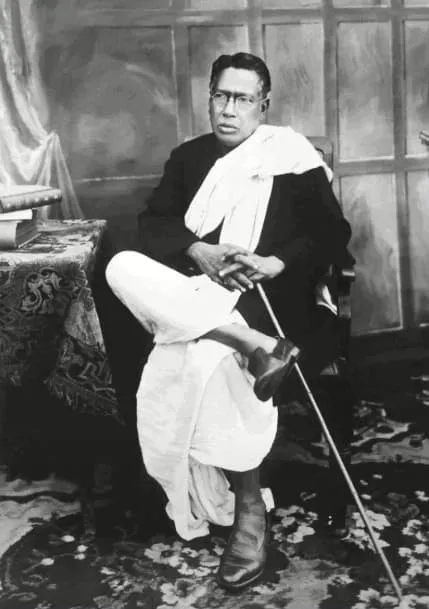
This chapter
A village in Sylhet
Bipin Chandra Pal was born on 7 November 1858 at Poil, in the Habiganj area of Sylhet district — a corner of eastern Bengal that is today part of Bangladesh. The date is unusually well fixed for a nineteenth-century Indian childhood: it was printed, with the date of his death, on the commemorative stamp issued at his birth centenary in 1958.
His father, Ramchandra Pal, was a landholder connected with the Sylhet bar and a scholar of Persian — the administrative and literary language of pre-British north India, still culturally live in the households of the Bengali gentry. Accounts of the household describe an unusual combination: a man observant in Hindu practice who also read seriously in Islamic learning. Pal's later insistence that Indian nationality was composite rather than singular did not arrive from nowhere.
The year of his birth was itself a hinge. In 1858, following the uprising of 1857, the East India Company's Indian territories were transferred to the British Crown. Pal grew up under a state that was, in his own lifetime, still assembling itself — a fact worth holding on to, because it makes his politics less a rebellion against something ancient than an argument with something recent.
A Maulvi, a mission school, and an unfinished degree
Pal's first instruction came at home, from a Maulvi — a Muslim teacher — before he entered Sylhet Government High School, where he passed the Entrance Examination. He then went to Calcutta, the administrative and intellectual capital of British India, to continue his studies.
What happened next is one of the details on which the record is not clean, and it is worth being explicit about it rather than picking a version. Some accounts place him at Presidency College; others at the Church Mission Society College, later St Paul's Cathedral Mission College, affiliated to the University of Calcutta. What every account agrees on is the outcome: he left without completing his degree.
This mattered practically. A Calcutta degree in the 1870s was the entry ticket to the colonial professions — law, government service, college teaching. Pal did not obtain one, and the careers that followed were correspondingly precarious. It also mattered intellectually. His learning was largely self-directed: extensive reading in Hindu philosophical texts, in English political and economic writing, and later in comparative religion. He was, in the exact sense, an autodidact who spent his life arguing about how education should work.
Headmaster, then librarian
From 1879 Pal worked as a school headmaster, in more than one place. Teaching was one of the few respectable occupations open to an educated Bengali without a degree, and it put him in front of an audience daily — a rehearsal, in effect, for the lecture halls of the next decade.
In 1890–91 he served as librarian and secretary of the Calcutta Public Library. It is easy to pass over this appointment. It should not be. A public library in late-nineteenth-century Calcutta was one of the few places where an Indian without institutional patronage could read widely in English political economy, history and periodical literature — and where he would meet the men who were beginning to organise Indian public opinion.
It was in these years that Pal came into contact with figures of the Bengal reform movement, among them Keshab Chandra Sen, whose Brahmo preaching drew him. Banglapedia records that it was Surendranath Banerjea who drew him into active politics.
By the time he was thirty, then, Pal had assembled an unusual set of tools: a teacher's fluency in front of an audience, a librarian's reading, a reformer's willingness to break social rules, and no professional stake in the colonial system to protect.
Surendranath Banerjea inspired Bipin Pal to take part in active politics.
Banglapedia, National Encyclopedia of Bangladesh
The Brahmo Samaj
A reform movement within Hinduism that rejected image-worship and caste restriction, and campaigned on the treatment of women. Joining it was not a private spiritual decision. It was a social position with consequences.
Pal joined the Brahmo Samaj, and it shaped the rest of his intellectual life.
The Samaj gave him three things that recur throughout his writing. First, a habit of religious argument conducted in the language of reason and comparison rather than authority — which is why he could later go to Oxford to study comparative theology and preach from Unitarian pulpits in England without any sense of contradiction.
Second, a commitment to social reform as a condition of political freedom, not a distraction from it. Pal opposed caste restriction and supported widow remarriage; his published work includes writing on the basis of social reform and, much later, a study of the Brahmo Samaj and the struggle for Swaraj, published in 1945 after his death.
Third, and least comfortably, an experience of being on the wrong side of his own community. Reform in nineteenth-century Bengal was not applauded. It was punished.
The marriage that cost him his family
After his first wife died, Pal married a widow. In the Bengal of his day, and in a Kayastha household, this was not a private choice. It was a transgression, and it was treated as one.
Hindu widow remarriage had been legalised in British India in 1856, two years before Pal's birth, but legality and social permission were entirely different things. Widows were expected to remain unmarried, and a man who married one placed himself outside the norms of his caste community. Pal's marriage is recorded alongside his entry into the Brahmo Samaj, and the two acts belong together: a religious and a domestic position taken at the same time, in the same direction.
The consequence was estrangement from his family and the loss of the economic security that came with it. It is one of the reasons his later life was financially insecure in a way that the careers of many of his contemporaries were not.
It is also, arguably, the most consistent thing about him. Pal's politics repeatedly involved refusing an accommodation that was available to him — a degree, a family's approval, a witness box. The refusals were expensive each time.
The event
A second marriage, to a widow
Widowed young, Pal remarried — choosing a widow, and joining the Brahmo Samaj. His family broke with him over it.
The idea
Why social reform was a political argument
Pal belonged to the wing of Indian opinion that refused to postpone social questions until after political freedom. His position was that a people practised in enforcing hierarchy on its own members would not know how to operate a free polity. Reform was not preparation for politics; it was the same argument, conducted at home.
The first newspapers
Pal's journalism begins in the 1880s, in Bengali, in a district town — not in Calcutta and not in English.
Paridarshak
c. 1880s
A Bengali weekly published from Sylhet, with which Pal was associated as editor. Sources give differing years for the association — 1880 and 1886 both appear in the reference literature — so the decade is stated here rather than a single date.
Bengal Public Opinion
1882
Pal worked as assistant editor. An English-language Calcutta paper: his entry into the metropolitan press.
The Tribune, Lahore
1887
Editorship of a major Punjab newspaper — a significant appointment, and evidence that his reputation had already travelled well beyond Bengal by his late twenties.
New India
1901
An English weekly started by Pal in Calcutta. Accounts date its launch to 12 August 1901. This is the paper in which his mature political voice takes shape, five years before Bande Mataram.
Into the Congress
The Indian National Congress was founded in 1885. Pal attended its sessions from the following years, and the causes he took up there tell you what kind of politician he intended to be.
At the Madras session of 1887 he argued for the repeal of the Arms Act — the legislation that restricted Indians' possession of firearms while leaving Europeans in India largely unaffected. It is a revealing choice of first major intervention. The Arms Act was not an economic grievance or a demand for office. It was a law that encoded, in the plainest possible terms, that Indians were subjects rather than citizens.
He also took up the condition of labourers on the Assam tea plantations — workers recruited under indenture-like terms and subject to penal contracts. That, too, is characteristic: an issue of ordinary working people's coercion, raised in a body then dominated by lawyers and professionals.
Through the 1890s Pal moved steadily toward the position that petitioning the government was insufficient. That conviction, held in common with Tilak in Maharashtra and Lajpat Rai in Punjab, would define the next phase of his life.
Oxford, 1898
In 1898 Pal sailed for England to study comparative theology at Manchester College, Oxford. He completed one academic year of a two-year course.
The choice of subject is not a detour from his politics; it is continuous with it. Comparative theology — the study of religions set side by side rather than ranked — was the intellectual apparatus of the Unitarian and Brahmo world he already belonged to. While in Britain he travelled and preached from Unitarian pulpits.
Two things followed. He acquired first-hand knowledge of British public life, which made him a more dangerous critic of it than a man arguing from Calcutta alone. And he acquired a framework for the argument he would later make about Indian nationality: that a civilisation is understood by comparison, not by assertion, and that India's was formed from more than one source.
He returned to India and, in 1901, started New India. The apprenticeship was over.
He travelled the British Isles, preaching from Unitarian pulpits.
South Asian Britain: Connecting Histories
on Pal's residence in Britain, 1898–99
Pal returned to Britain twice more — in 1908, after prison, and in 1919. Both visits are covered in Later Years.
Chronology — the first half of a life
Select an entry to open its context. Dates that reference works dispute are marked.
Bengal Presidency
Born to Ramchandra Pal, a landholder connected with the Sylhet bar and a scholar of Persian. The same year, the East India Company's Indian territories passed to the British Crown.
then Calcutta
Early instruction from a Maulvi at home; Entrance Examination passed at Sylhet Government High School; then to Calcutta for college, which he left without a degree. Reference works disagree on which college he attended.
Several stations
Teaching was one of few respectable occupations open to an educated Bengali without a degree. Pal held headmasterships in more than one place.
Year disputed
Pal's editorial association with the Sylhet weekly Paridarshak is well attested; the year is not. Both 1880 and 1886 appear in reference works, and this site does not choose between them.
English language
His entry into the metropolitan English-language press, and the beginning of a bilingual journalistic career that ran for four decades.
A national reputation
Editorship of a leading Punjab paper, and at the Congress session in Madras a plea for repeal of the Arms Act — the statute that disarmed Indians while leaving Europeans in India largely untouched.
Reading years
An appointment that placed him among books and among the men organising Indian public opinion. It was in this period that he was drawn to Keshab Chandra Sen's Brahmo preaching.
Comparative theology
One academic year of a two-year course in comparative theology. He travelled in Britain and preached from Unitarian pulpits, acquiring direct knowledge of the political culture he would spend the next decade opposing.
Calcutta
An English weekly of his own. From this point Pal has a platform he controls, and the argument that will define the decade — Swadeshi, boycott, Swaraj — begins to take printed form.
Sources for this chapter
- “Pal, Bipin Chandra”, Banglapedia: National Encyclopedia of Bangladesh — birth, family, schooling, headmasterships, Calcutta Public Library, journals, Congress.
- “Bepin Chandra Pal”, South Asian Britain: Connecting Histories — the 1898–99 residence, Manchester College Oxford, Unitarian preaching.
- Encyclopaedic entries on Bipin Chandra Pal for the Arms Act plea at the Madras Congress session of 1887, the Brahmo Samaj, the second marriage and advocacy for Assam tea labourers.
- India Post commemorative stamp, birth centenary issue, 7 November 1958 — corroborating the birth and death dates.